
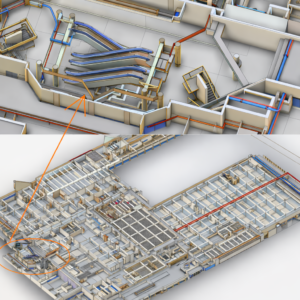
At 5D Geo, we take our name from the five dimensions of BIM — 3D geometry, time and cost. It is a deliberate statement of intent. A 3D model of existing conditions is only the starting point. What matters is what you do with it, and whether it was built accurately enough to be trusted when decisions get expensive.
In our experience, when a client tells us a scan-to-BIM model was useless, it rarely was a complete waste of resources. What it failed to deliver was certainty about the as-built conditions at the right level of detail. That is a different problem and one that surfaces earlier in the process than most clients realise, when it is still cheap to fix.
The scan and modelling costs are known upfront. What is often not understood is the cost of discovering, on site, mid-construction, that the model did not truly represent existing conditions. That is where projects get expensive.
With over 60 years of combined principal experience across sub-Saharan Africa, scanning live industrial plant, warehouses, occupied commercial buildings and infrastructure, we have seen the same causes repeat. Here are the most common ones.
The scope was never properly defined
Before we quote anything, we give clients a checklist of building elements and ask a simple set of questions. Do you need walls, columns, slabs, stairs, structural steel? Do you need mechanical, electrical, plumbing and fire systems included? Do you need plant and equipment captured and modelled?
Critically, we ask why. Understanding the intended use of the model allows us to bring our experience into the conversation early, before commitments are made that are difficult to reverse.
That checklist defines the model. Without it, a supplier will interpret “a BIM model” however suits them. The client receives something that opens in Revit, looks complete, and answers none of their actual questions. It also does a poor job of removing risk from the design process, which is the primary reason for commissioning it in the first place.
The cheapest option was selected without checking if it was the right one
Scanning services vary considerably. Some firms are competent in commercial offices and straightforward buildings. Far fewer have genuine experience modelling live industrial plant, dense pipework, running equipment, confined access, hazardous environments. These require a different skill set entirely, and there is a real learning curve to doing them well.
Penny wise and pound foolish is an apt description of what happens when that distinction is ignored.
If you are collecting three quotes, make your proposal request work harder. Ask each supplier: what similar facilities have you scanned in the last 12 months? Can I speak to the project surveyor directly, not the sales contact? Can you provide references from comparable work? Treat it as a job interview, because that is precisely what it is.
Some buildings are genuinely difficult to scan
This is something suppliers rarely mention in proposals, but clients deserve to know it upfront.
Specular surfaces, polished stainless steel, glass vessels, chrome pipework, scatter laser returns and introduce noise into the point cloud. Dense pipework creates occlusions that no single scan position fully resolves. When we scanned a petrochemical plant in Secunda, careful pre-planning of scan positions before site attendance was the difference between a complete dataset and one full of shadows in exactly the wrong places.
A competent scanning team will tell you in advance which areas present these challenges, what supplementary methods will address them, and what the model will and will not show. If a proposal does not mention any of this, ask directly. The answer will tell you a great deal.
And sometimes, 3D scanning is not necessary at all
A competent traditional measured survey is sufficient for many buildings. If the scope is straightforward, partition layouts, floor areas, basic structural elements, a good surveyor with conventional equipment may deliver the same outcome at lower cost.
Where 3D scanning earns its place is when the building is complex, existing records are poor or absent, and the cost of an error during construction materially exceeds the cost of the survey. A live plant room with no reliable drawings is the obvious case. So is any building where structure, M&E and fire protection need to coordinate in confined space.
In those situations, our point cloud accuracy runs to better than ±5mm. Modelling accuracy is consistently better than 10mm. That is the baseline we quote against and deliver to.
The short version
Define your building elements upfront. Verify that your supplier has relevant experience with your building type. And be honest about whether scanning is necessary at all, sometimes a targeted scan of one critical area combined with a traditional survey is the most practical answer.
If a scoping checklist would help start that conversation, contact us and we will send one across. It costs nothing and it may save you a considerable amount.
0 Comments